
How to spot a fake or ghost remote job yourself
You find it at 11pm. Senior customer success manager, fully remote, $120k to $140k, async-first team, apply in two clicks.
You scroll down. Posted 187 days ago.
Reposted last Tuesday. And the Tuesday before that. Same title, same vague description, no names, no team, no hiring manager. Just "fast-growing company seeks rockstar" and an urgency banner that says "Act fast, closing soon."
That posting has been closing soon for six months.
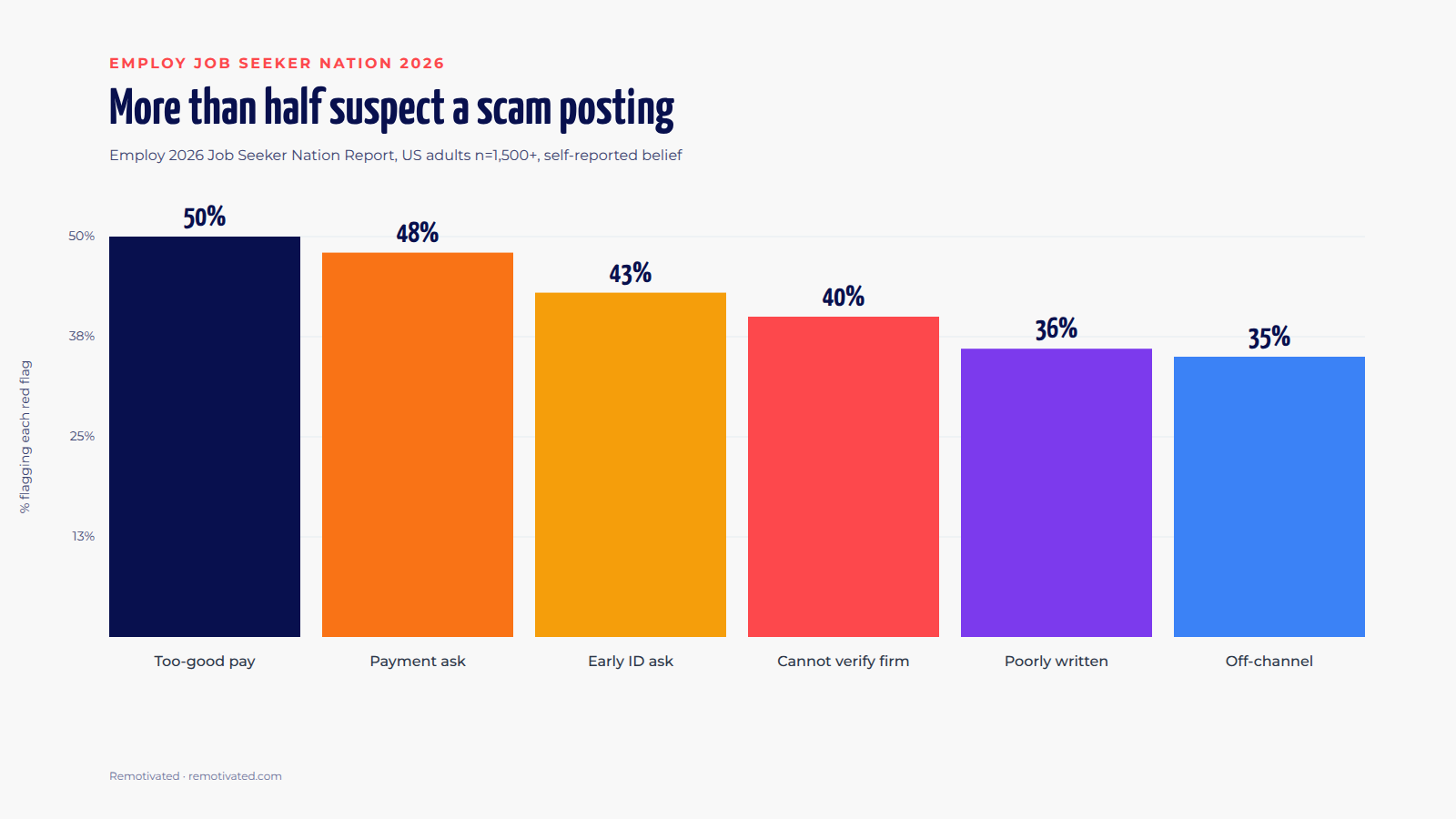
You are not imagining it. In the Employ 2026 Job Seeker Nation Report (archived), a survey of more than 1,500 U.S. adults, 53% of candidates say they have run into a posting they believed was a scam.
The tells they name most are blunt. Pay that looks too good to be true (50%) and outright requests for payment (48%). Further down the same list sits the one that matters for ghosts: the company could not be verified (40%). Those are self-reported beliefs, not adjudicated fraud cases. The feeling still points at something real.
Ghost postings and scam postings are not the same problem. But they fail the same test. You cannot tell who is really hiring.
Here is how we check, and how you can check too.
Before the ghost signals, run a 30-second remote reality check. It prevents the most expensive failure for experienced seekers: three interview rounds for a role whose remote claim falls apart. Does the posting name the hiring zone or countries, or does it just say remote while the fine print names a hub city or hybrid schedule? Does it describe overlap hours, team size, and async norms, or only adjectives? If zone plus norms are missing, treat that as fail before you run the ghost tests below. Note: a city requirement is a flexibility flag, not a ghost signal. That distinction lives in our Hiring Zones piece.
First, separate three things people lump together
Not every stale posting is a ghost. Not every ghost is a scam.
- A slow hire. Real role, real team, slow process. Startups pause searches, freeze headcount, then restart. The posting looks old because the process was messy.
- A ghost job. No active role behind the posting. Sometimes it is pipeline building ("always accepting applications"). Sometimes it is signaling ("look how fast we are growing"). Sometimes it is just neglect. Nobody took it down.
- A scam listing. Someone wants your money, your identity documents, or a move to WhatsApp or Telegram to "continue the interview." In that same Employ survey, 36% flag a poorly written description and 35% flag an unofficial channel like WhatsApp. That pair is the classic tell.
Treat all three with the same opening move: verify before you invest.
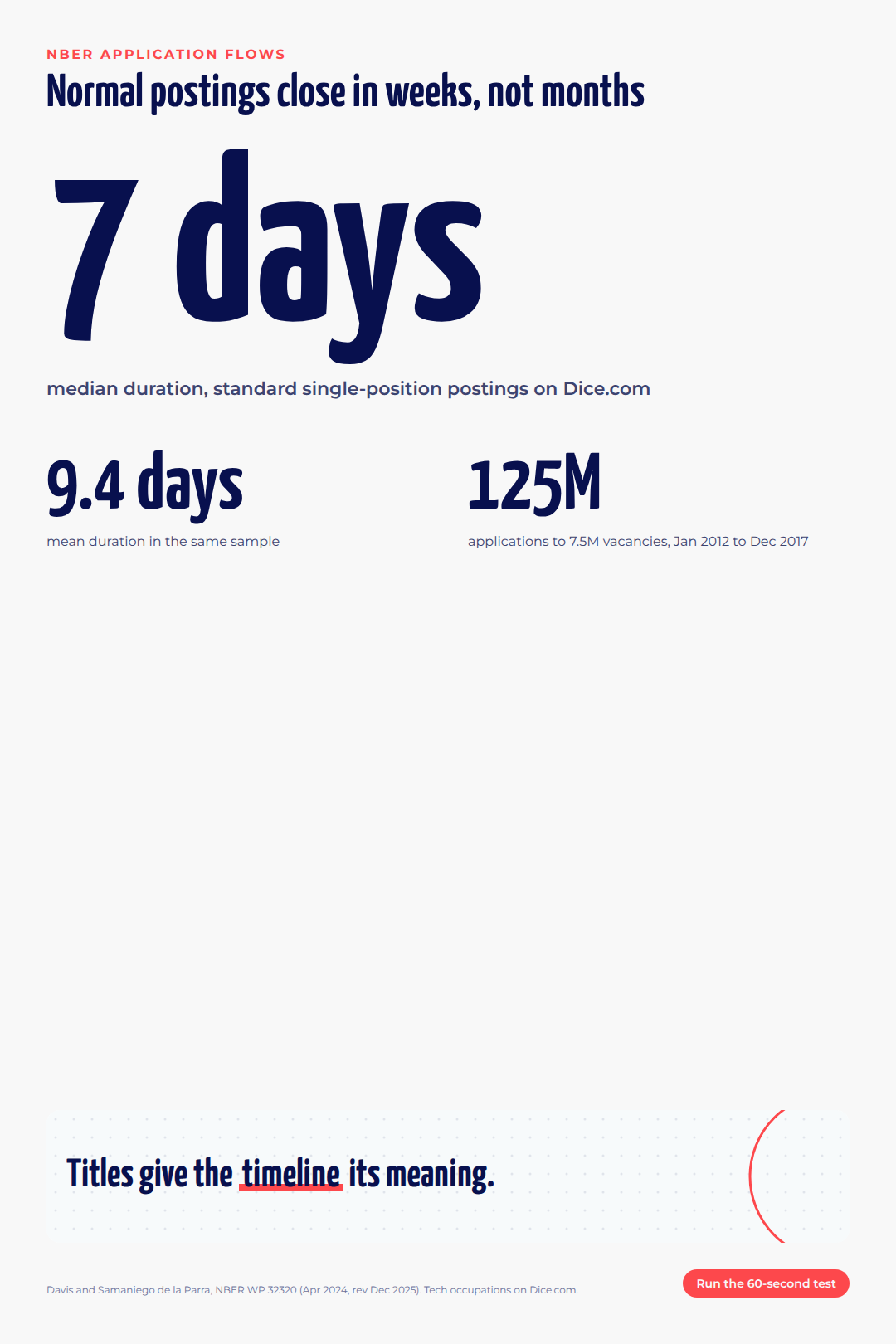
For context on what normal looks like: NBER research analyzing 125 million applications to 7.5 million vacancies on Dice.com (archived) found a median posting duration of 7 days and a mean of 9.4 days for standard single-position postings. That is older tech data from 2012 to 2017, not today's remote market, but the shape holds. Most jobs fill or close in weeks. A posting live unfilled for six months is the outlier. It owes you an explanation.
Signal 1: Read the title and the timeline together
How long a posting has been live tells you almost nothing until you ask what job it is for.
A senior posting sitting open for a while can be completely normal. A Staff Engineer, a Head of Finance, a Senior Product Designer. There is usually one of those seats. The company can afford to wait for the right person, and a long search often means they have a high bar, not a fake role.
The pattern that should worry you is different. It is a one-of-one senior title getting reposted every week, with identical copy, for months.
Real senior searches evolve. The description gets sharper. Requirements get edited. The salary band moves. The posting closes while they interview, then reopens if nobody signs. A weekly repost with zero change is not a picky hiring manager. It is a placeholder. There is no active search behind it, just a feed that keeps refreshing.
Flip it for high-volume roles and the logic reverses.
An old or constantly reposted Sales Development Representative (SDR) or support rep posting often just means the company hires that role in batches. Ten SDRs, twenty support reps, always-on pipeline. That can be legitimate.
Then the real question stops being "is this a ghost" and becomes "why are they always hiring for this seat."
Two versions of always hiring:
Growing (good): They are hiring SDRs plus engineers plus designers plus ops. Employee count on LinkedIn trends up over six months. The posting mentions team size, ramp, quota, and who you report to. Reviews mention busy but functional onboarding.
Churning (bad): It is only ever that one SDR posting. Same title, same vague promise of uncapped commission, no team name, no manager name, no ramp detail. Reviews and short LinkedIn tenures mention burnout, a revolving door, or comp that never materializes. That is not growth. That is turnover with a job ad attached.
So use this quick filter: a one-of-one senior title plus weekly reposts plus identical copy is a big red flag. A high-volume title plus constant reposts is normal until proven otherwise, then check whether the rest of the company is growing with it. Titles give the timeline its meaning.
Signal 2: Vague pay paired with artificial urgency
Vague pay alone is not proof of anything. Plenty of legitimate companies still post wide bands.
The tell is the combination. "Competitive salary" or a $70k to $200k band, plus "Immediate hire!" plus "Only 2 spots left!" plus "Apply now before we close applications!"
Legitimate urgency is specific. It names a date, a reason, a stage. "We are interviewing this week for a September start" is verifiable. "Act fast" is not.
If pay is vague, look for the other half of the compensation story the posting should still answer: employment type, location and hiring zone, time expectations. A real remote team will tell you where you can live, what hours overlap they expect, and who you report to. A ghost gives you adjectives instead.
Signal 3: No named humans, no named team
This is the one we weight most.
A real remote job lives inside a real team. Even a short posting usually names the hiring manager, the team size, or how the team works. "You will join our 6-person support team, reporting to Maya, working async across US and EU time zones."
A ghost posting talks about "the company" and "the ideal candidate" and never introduces a person. No hiring manager. No team. No description of meeting norms, async expectations, or decision making. No link to a team page with actual faces on it.
Try this 60-second test: click through to the company site and check whether the careers page lists this role with the same title. Check whether the company LinkedIn page shows people with that job title already doing that work. See whether you can find the hiring manager or department lead in two clicks.
If you cannot verify the team exists, do not send your resume into the void. Save your best energy for teams you can see.
Signal 4: The application goes nowhere, or everywhere
Two opposite patterns, same problem.
Pattern A is the black hole. You apply through a third-party form that asks for your full address, date of birth, and references upfront, before any human contact. No confirmation email from the company domain. No Applicant Tracking System (ATS) page with the company logo. Just silence. In that same Employ survey, 43% flag early asks for identity documents. Upfront sensitive asks before any human contact belong in this bucket.
Pattern B is the instant redirect. You click Apply and land on a chat app, a personal Gmail address, or a form that asks for payment for training, equipment, or a background check. Legitimate employers do not charge to apply. If you are asked for a fee, especially in advance, walk away and report the listing.
A real remote application has friction in the right places. It asks for work samples. It tells you the steps. It comes from the company domain. It respects that your time is the scarce resource.
The honest counterpoint: sometimes an old posting is real
We would be lying if we said age alone settles it.
Some roles are genuinely hard to fill and stay open for months. Senior infrastructure, security-cleared support, multilingual sales. Some companies run evergreen pipelines for support or sales and will tell you so, plainly: "We hire for this role quarterly." That is honest pipeline building, not ghosting, because they label it.
The difference is transparency. A legitimate long-lived posting explains why it is still open. It updates the date. It names the team. It answers follow-up questions. A ghost cannot do any of that, because there is nobody home.
When in doubt, send one short note before you do a full tailored application: "Hi [Name], I saw the [Title] posting from [Month]. Are you still actively hiring for this? If so, what does the timeline look like from here?" No answer, or a copy-paste answer with no name on it, is also an answer.
What to do instead of playing detective all day
Yeah, this checking takes time. That is the point nobody likes to say out loud.
Jobseekers should not need an investigation workflow to apply for a job. The tools you use should tell good from bad before you ever see the listing.
This is literally what we do all day at scale.
At Remotivated we check companies for genuine remote status, we trace listings to active employer pages, and we pull stale or unverifiable postings instead of letting them recycle for another six months. You still bring judgment. We remove the ghosts before they reach you.
Start with the remote reality check plus the 60-second team test on your next three applications. If two of them fail, stop applying on that board. Your time is better spent where the teams are real.