In early June, Meta's chief technology officer dropped two numbers into an internal post.
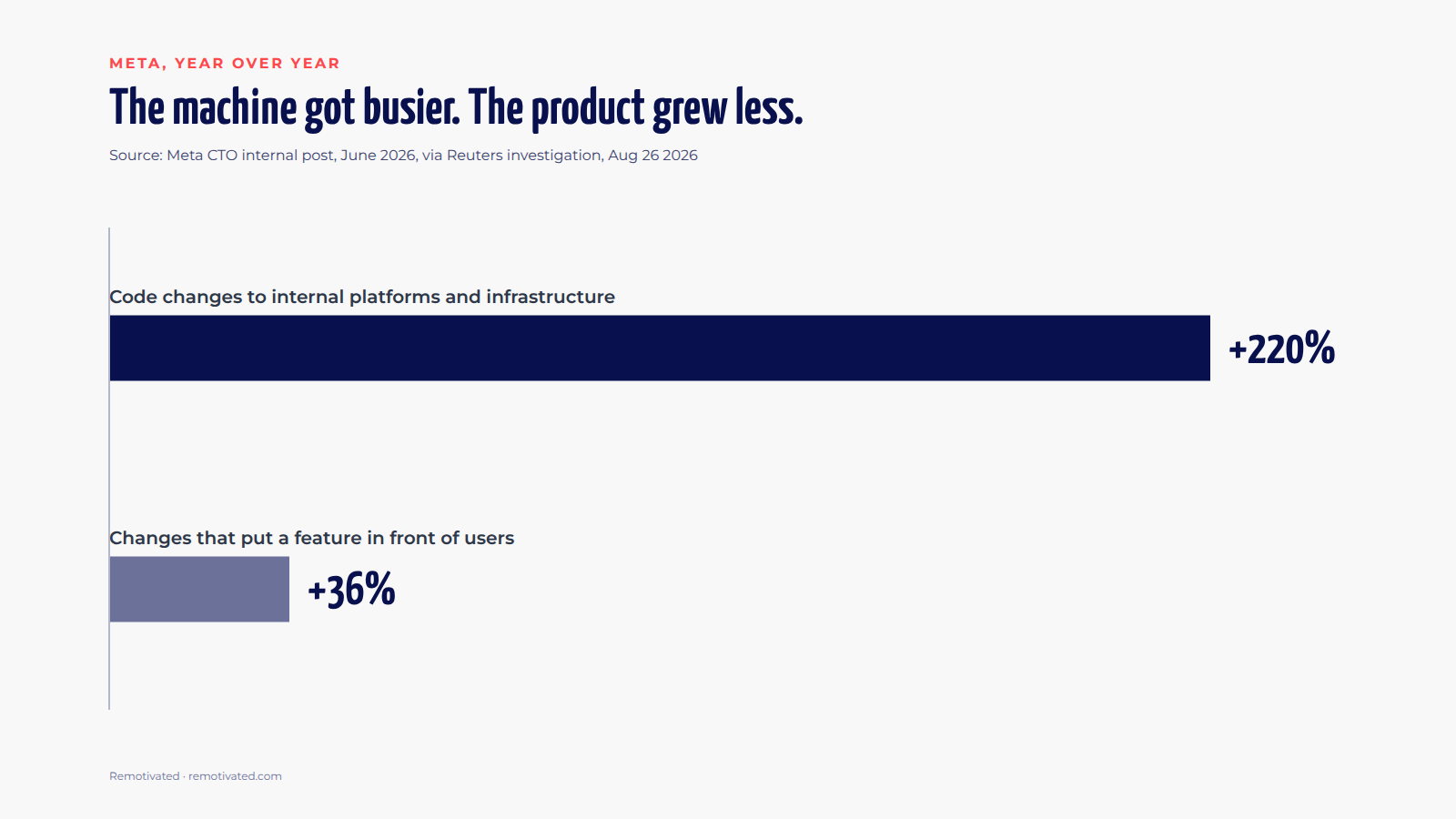
Code changes to the software platforms and infrastructure Meta employees use every day: up 220% year over year.
Changes that put a new or upgraded feature in front of Meta's users: up 36%.
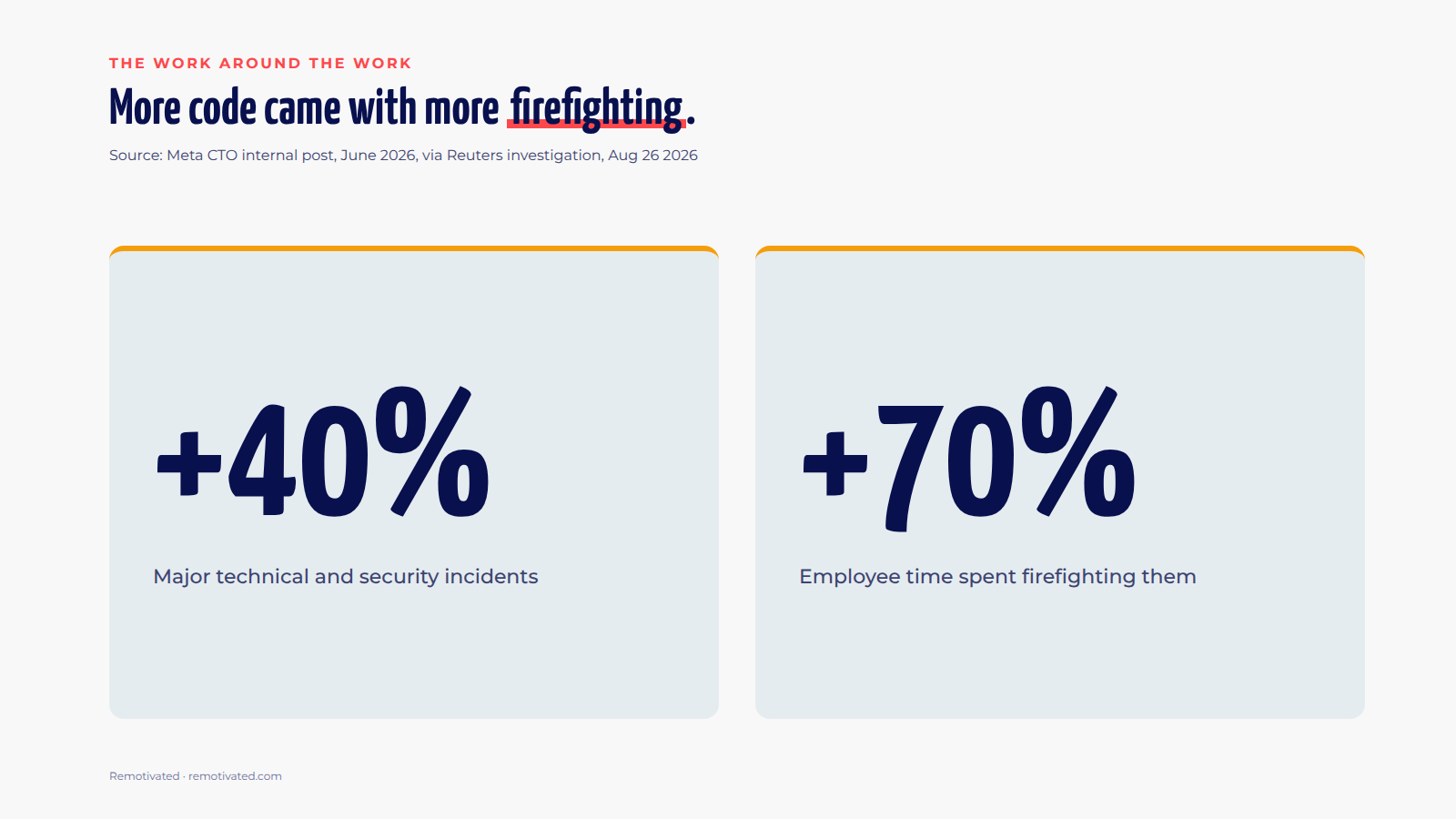
You can't divide one by the other and claim Meta captured some exact fraction of the potential gain. A 36% increase in user-facing changes might be genuinely good on its own, and the two metrics don't share a clean denominator. But the direction is hard to miss. Machine-assisted activity exploded. Customer-facing output grew more modestly. And over the same year, major technical and security incidents rose 40% while the time employees spent firefighting them rose 70%.
That is the gap between a machine that is busy and a company that is productive.
That gap is the thing to understand if you are weighing an offer from a company that calls itself "AI-native," or if you were laid off by one. Meta did not wait for AI agents to prove they could carry large parts of the work. It started redesigning the organization around the assumption that they soon would. The plan is now public.
Meta reorganized around a forecast
A Reuters investigation published August 26 revealed a previously unreported initiative called Project OT, short for "Organization Transformation."
It started in January, when Mark Zuckerberg and his senior team met at his compound in Hawaii to sketch what an "AI-native" Meta might look like. In that picture, AI agents do much of the daily work employees handle now, while smaller, "talent-dense" groups of humans supervise the virtual workforce.
The scale they sketched was not incremental. In Project OT's most aggressive scenarios, Meta explored shrinking some teams by as much as 60%. A conventional product team of 10 to 20 specialists might become a pod of three to five generalist "builders," with specialists shared across pods and fewer layers of formal management. Reductions could come through layoffs, reassignment, closing open positions, and pushing out people the company considered poor performers. An internal human-resources projection contemplated cuts as large as, or larger than, the roughly 25% reduction Meta carried out in 2022 and 2023.
Meta says those figures were scenarios, not an approved plan. The 60% figure applied only to some teams, several major units were excluded, and the company never intended to eliminate 60% of its total workforce. A scenario is not a layoff order, and the distinction is fair.
But scenario planning is still evidence of what leadership thought was plausible. A 60% reduction does not appear in a one-year planning exercise unless executives believe a very large share of what employees currently do could soon be automated, consolidated, reassigned, or dropped. Meta's leaders thought it realistic that, within about a year, some teams could lose most of their people because agents would absorb the rest.
They did not wait for the technology to prove it.
Meta went ahead with the first wave in May. About 10% of employees were laid off, thousands more were moved into AI-related initiatives, and, according to an internal document Reuters reported on in May, 6,000 open roles were closed. Hours before the layoffs began, Zuckerberg called off planning for a second wave that had been expected in November. Reuters could not determine exactly what prompted the reversal. The next morning he told the remaining workforce he did not expect further company-wide layoffs that year.
By then, the CTO's own numbers were already undercutting the premise.
AI productivity: more code is not more output
The 220% jump in internal code changes is exactly the kind of number that makes an AI transformation deck sing. It is big, it is concrete, and it looks like proof that people using AI are producing dramatically more.
But code is an intermediate output, not the product. More code can just as easily mean more reviews, more regressions, more duplicated effort, more vulnerabilities, and more work for the humans responsible for checking what the systems produced.
Meta's internal posts described that bill coming due. Infrastructure teams were warning about "reliability warning signs" as early as March. An April post said unchecked agents were taking "large-scale, disruptive actions that humans are unlikely to execute." Major technical and security incidents, including service disruptions and possible data leaks, were up 40% from the previous year. Time spent firefighting them was up 70%.
None of this proves AI created no value at Meta. That 36% increase in changes that reached users suggests it did. What it shows is that the available results came nowhere near establishing that some teams could safely lose most of their people. AI increased the system's capacity to produce. It did not remove the need for judgment, review, testing, coordination, or accountability.
In some cases it just moved the human work. Less writing code, more inspecting, correcting, and containing what agents wrote.
Companies increasingly measure AI activity as if it were AI productivity, because activity is what fits on a dashboard. Token use, generated code, agent actions, adoption rates. All countable. Customer outcomes, avoided failures, sound judgment, institutional resilience. Not countable, at least not as easily. So leaders reach for the visible numbers and build the transformation story around them. The agents produce more possible work while the company still needs people to decide which of it is useful, whether it is correct, and what can safely ship.
Meta is not the only company that got this wrong
Project OT is unusually well documented, but the pattern is not unusual. And it is not limited to engineering.
Klarna stopped hiring in late 2023 and, from February 2024, presented its AI customer-service assistant as doing the work of 700 full-time agents. In December 2024, CEO Sebastian Siemiatkowski said he was "of the opinion that AI can already do all of the jobs that we as humans do."
By May 2025 he was telling Bloomberg something different: Klarna had focused too much on cost, the result was lower quality, and the company was recruiting human customer-service workers again so customers would always have the option of talking to a person.
Commonwealth Bank of Australia ran a faster version of the same cycle. In July 2025 the bank cut 45 customer-service roles, saying its new AI voice bot had already reduced call volumes by 2,000 a week. Union members said the opposite was happening: calls were rising, management was scrambling to offer overtime, and team leaders were being pulled onto the phones. Within a month the bank conceded it "did not adequately consider all relevant business considerations," called the redundancies an error, apologized, and gave the affected employees the choice to stay, redeploy, or leave.
The technology in these cases was not useless. Klarna's assistant handled real volume. Commonwealth Bank's bot answered calls. Meta's coding tools generated an enormous amount of activity.
AI did something. It did not do the thing in the planning deck.
That difference gets expensive when companies make irreversible employment decisions on projected capability rather than demonstrated performance. Institutional knowledge does not wait on a shelf while management tests a replacement. Once experienced people leave, getting equivalent knowledge back is slow, costly, and sometimes impossible.
Meta undercounted the work around the work
The most revealing part of Project OT is not that Meta's technology forecast was wrong. Forecasts are wrong all the time, and agent systems will keep improving. The question is why Meta's leaders believed cuts of up to 60% on some teams could be feasible before those gains had shown up.
That belief becomes possible when leadership defines a job by its most visible artifact. An engineer produces code. A designer produces screens. A support agent closes tickets. A product manager produces plans. Make those artifacts cheap to generate and, in this view, you need far fewer people.
A functioning organization is more than a pile of artifacts.
People decide what should be built in the first place. They carry dependencies nobody ever wrote down. They notice when a technically plausible change will create a security problem three systems away. The support agent who realizes the fifth "simple" call this week is the same product defect, and escalates it, is doing work the bot cannot see. So is the recruiter who kills a bad requisition before it wastes a quarter. People negotiate competing priorities, push back on bad assumptions, review each other's work, and take responsibility when something breaks.
They also stop bad work from happening. That contribution is hard to measure because its value usually shows up as an absence. The feature that never shipped because an experienced engineer saw it would expose user data is not on any productivity dashboard. Neither is the outage that didn't happen because someone questioned a plausible-looking change. Institutional knowledge tends to become visible only after the person carrying it has left.
AI makes generating possible work dramatically cheaper. That makes judgment about which work is worth doing, and whether it is safe, more valuable, not less.
Meta scaled up production before it understood the matching need for review, control, and accountability. It got more output with a much larger blast radius.
Employees understood exactly what was happening
Meta employees were not just being asked to adopt new tools. Many were being asked to train the systems that might eventually replace parts of their jobs.
Engineers were reassigned to an Applied AI Engineering unit where they wrote software-engineering puzzles and other training data for Meta's models. In internal posts, employees called some of that work rote and boring. The company also installed software on U.S. employees' computers that could record keystrokes, mouse movements, and other activity so AI agents could learn how humans do computer-based work. Employees initially had no way to opt out. After weeks of protest and an internal incident in which employee data was exposed, the program was paused.
At the same time, Project OT was rolling out a different management structure. In the "village" model described in one unit's internal announcement, pods of three to five builders reported into larger groups led by an "Org Lead." Some pod leads were expected to coordinate work without formal management authority, manager training, or access to the ratings and promotion tools. One of them put it plainly on an internal message board: "I'm not going through manager training, and I'm not getting access to ratings & manager tools." Rating and promotion decisions, the announcement said, could be supported by unspecified "AI systems." Meta told Reuters those decisions "were and are made by people, not AI."
Seen separately, each change could be framed as an experiment. Seen together, the message was clear. Employees were being measured, reorganized, and assigned to train systems while leadership modeled a future in which many teams would need far fewer of them.
They reacted accordingly. Employees replied to executive announcements with pictures of elephants, for the layoffs nobody would discuss. More than 1,500 signed a petition against the tracking program, according to reporting on an internal memo in June. Internal debates turned confrontational, including with the CTO, who defended the AI transformation in the comments. Meta's favorable employee-sentiment score fell from 74% to 55% between two half-year Pulse surveys.
It would be convenient to file that under ordinary resistance to change, but employees were not imagining the replacement threat. Project OT explicitly envisioned agents taking over daily work while smaller human teams stayed on to supervise them. Trust fell because replacement was one of the transformation's contemplated outcomes, and employees were expected to help produce the data and systems that could make it happen. No amount of better internal comms fixes that.
Executives kept the option to cancel the November wave when the technology failed to move as fast as they expected.
The people laid off in May did not get the same option.
What this looks like from outside, before you apply
"AI-first," "AI-native," and "agentic" tell you almost nothing about whether a company uses AI well. An employer can deploy AI everywhere and still measure the wrong things, generate more output while shipping little additional value, automate decisions without deciding who is accountable for them, and flatten teams without understanding what the managers and specialists were preventing. AI maturity is not a headcount ratio.
A mature employer does not start from a dramatically smaller org chart and work backward, hoping the technology catches up. It starts with real workflows, asks where AI has demonstrated reliable value, measures customer outcomes and rework and how much human intervention the system still needs, decides who owns a call when an agent gets it wrong, and tells employees honestly whether the goal is augmentation, replacement, or some mix of the two. Only after the new system has shown sustained gains does it decide how roles and team sizes should change.
You will rarely get to ask about any of that before an offer is on the table, and if you are job hunting with a runway, you may not want to spend interview capital on it. The good news is that the Meta, Klarna, and Commonwealth Bank stories share tells you can check from outside, as part of researching a company before you apply:
- Headcount targets announced before results. Layoffs or hiring freezes justified by AI, with no published outcome data (quality, reliability, customer metrics) to go with them. Earnings calls and press coverage carry this, and Meta's, Klarna's, and CBA's all did.
- An "AI-native" rebrand within months of cuts. Meta's "betting on people" campaign followed its May layoffs. A company that reversed an AI-driven cut, as Klarna and CBA did, is arguably a better sign than one that hasn't yet admitted anything.
- Employee-monitoring rollouts framed as AI training. Keystroke and screen capture "to teach agents" is a strong signal that the roadmap includes replacing the people being recorded. It tends to leak. Meta's did, within days, through internal comments and then the press.
- Job postings with generic "builder" titles, pod leads without management authority, or roles whose stated purpose is producing training data. These are Project OT's fingerprints. A listing that reads that way is telling you what the org chart is becoming.
- Leadership quotes that describe AI as already able to do the job. "AI can already do all of the jobs that we as humans do" was on the record five months before the retraction.
Questions to ask an employer about AI
When you do get to the interview, fold these into the "what to ask" half of your interview framework:
- Where has AI measurably improved customer or business outcomes, not just increased output?
- Where has the company scaled back or reversed an AI deployment because it didn't work as expected?
- Who is accountable when an agent takes an incorrect or disruptive action?
- How does the company measure productivity: generated work, or shipped value, reliability, and rework?
- Will this role build durable skills, or mainly produce training data for systems meant to absorb the work?
You don't need a polished answer, and honest uncertainty is healthier than a rehearsed line about how AI has transformed everything. What you are listening for is whether leaders can talk about tradeoffs, failures, and limits without getting evasive.
Employers increasingly ask candidates to disclose how they use AI during hiring. Candidates are owed the same transparency about how AI will shape the role they are being asked to take.
The technology may improve. The order of operations still matters.
In July, Zuckerberg told employees that agent technology had not "accelerated" as quickly as he expected, and that he anticipated more benefit over the following three to six months. Meta's public language shifted with it. The company launched a campaign saying it was "betting on people," and in an essay published in August, Zuckerberg wrote that invention, not automation, would be the greatest contribution of what he calls superintelligence, while still predicting that company sizes may shrink as small numbers of people run companies at significant scale.
That future is possible. Smaller teams may eventually do work that once took much larger organizations, and some roles will disappear while others change or appear. None of that justifies treating anticipated capability as established fact, and none of it requires deciding in advance that fewer humans must be the outcome. An organization that is serious about AI tests the technology, counts the incidents and reversals and review time alongside the code, and follows the evidence, including evidence that points away from the preferred story.
Meta ran the process backward. It planned to reorganize thousands of lives around a forecast of AI capability, started carrying out the human consequences, and then found that generating more work is not the same as creating more value.
It believed too much in AI, and too little in the work its people were already doing.
Sources
- Primary reporting: Reuters, "Mark Zuckerberg had a bold plan to replace Meta staff with AI. Here's how it imploded," August 26, 2026.
- Additional Meta reporting: Reuters on the May 20 restructuring document (6,000 open roles closed), May 18, 2026; Reuters on the tracking-program pause, June 22, 2026; Entrepreneur on the 1,500-signature petition, June 4, 2026; Mark Zuckerberg, "The Future is for Everyone," August 10, 2026.
- Klarna: February 2024 press release, Business Insider on Siemiatkowski's December 2024 Bloomberg TV remarks, Bloomberg on the return to human customer service, May 8, 2025 (paywalled; the quote is carried in Customer Experience Dive, May 9, 2025).
- Commonwealth Bank: AFR on the original cuts, July 28, 2025 (paywalled; the 2,000-calls figure is carried in Yahoo Finance Australia, July 28, 2025); ABC News on the reversal and apology, August 21, 2025.